

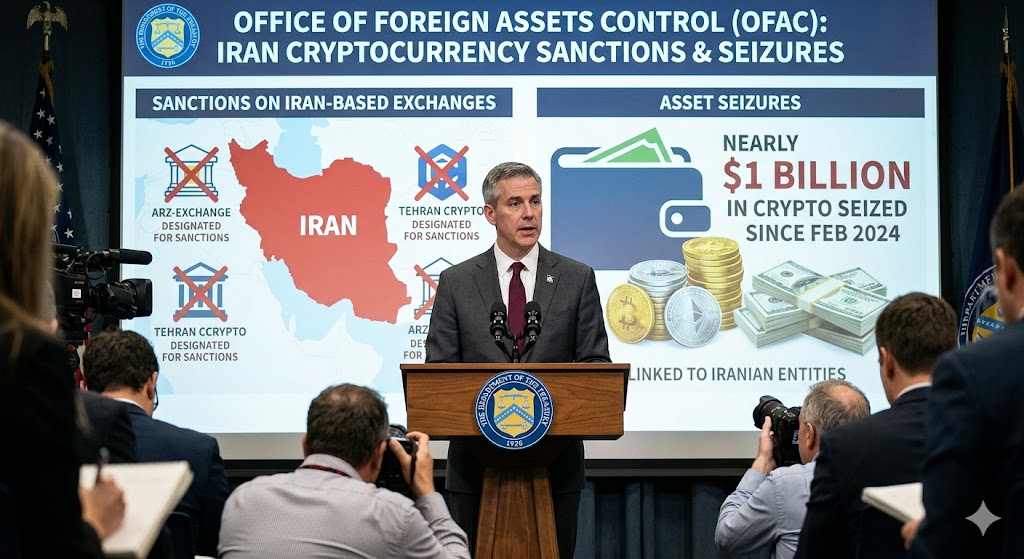
The US Treasury issues sanctions on four cryptocurrency exchanges operating in Iran, escalating Washington’s financial pressure on Tehran amid ongoing regional tensions. The designations, announced by the Office of Foreign Assets Control, follow Treasury Secretary Scott Bessent’s disclosure that US authorities have seized nearly $1 billion in crypto from Iranian-linked wallets and exchanges since late February.
Treasury Sanctions List Expands Amid Regional Policy Shifts
The latest additions to the Treasury sanctions list include four digital asset platforms accused of processing transactions for sanctioned Iranian entities and obfuscating the origin of digital funds. While the Office of Foreign Assets Control ramped up pressure on Tehran, observers note that treasury issues immediate sanctions relief for Syria even as it blacklists Iranian platforms, revealing a bifurcated sanctions strategy. Washington has intensified its reliance on blockchain analytics firms to track flows into Iranian exchanges, and the fresh designations give US authorities broader powers to freeze dollar-denominated assets and penalize non-US banks or technology providers that knowingly process related settlements. The near $1 billion seizure total disclosed by Secretary Bessent underscores the scale of enforcement activity underway since February. Legal experts caution that the extraterritorial application of these measures means any firm using US-dollar settlement infrastructure—even indirectly—must ensure its compliance frameworks can identify sanctioned addresses in real time. Exchanges with any nexus to Iranian financial infrastructure now face exclusion from correspondent banking channels and global stablecoin issuer networks, regardless of where their servers or legal entities are domiciled.
What This Means for Indian Crypto Holders
Indian investors rarely interact directly with Iranian exchanges, but the sanctions carry indirect compliance implications that extend well beyond Tehran. Indian trading platforms and over-the-counter desks maintaining dollar liquidity channels through international payment rails must now screen counterparties against the Treasury sanctions list to avoid secondary liability. New Delhi has historically aligned with United Nations rather than unilateral US designations, yet Indian banks with US correspondent relationships routinely enforce OFAC compliance to preserve dollar access. The seizures demonstrate that US authorities treat crypto mixing and obfuscation tools as sanctions-evasion infrastructure, a precedent that could shape how Indian regulators view privacy protocols and cross-border settlements. For Indian holders, the immediate risk is not token price volatility but counterparty exposure: any domestic or foreign exchange interacting with newly blacklisted Iranian wallets could itself face asset freezes, complicating withdrawals or rupee-to-dollar settlements without warning. Monitoring the treasury sanctions list directly is now a necessary due diligence step for any Indian entity processing international crypto payments.
What to watch
– Monthly OFAC updates to the Treasury sanctions list, particularly newly identified wallet addresses tied to Iranian platforms
– On-chain data from blockchain analytics firms showing stablecoin redemptions or exchange outflows from Middle East-facing custodians
– India-specific: Any Finance Ministry or RBI circular requiring domestic exchanges to pre-screen against US sanctions lists before processing international USDT or wire transfers
—
Frequently Asked Questions
Which Iranian crypto exchanges were added to the treasury sanctions list?
Treasury officials designated four exchanges accused of handling transactions for sanctioned Iranian entities. Specific wallet addresses and entity names will be published in the updated OFAC database within days.
Why is the US Treasury targeting Iranian crypto platforms?
Washington alleges these platforms laundered digital assets and helped sanctioned Iranian groups bypass financial restrictions. The $1 billion in recent seizures supports Treasury claims that crypto has become a key sanctions-evasion channel for Tehran.
Should Indian investors be concerned about US sanctions on foreign exchanges?
Yes. Indian holders using global platforms or OTC desks must verify that their counterparties are not processing transactions for sanctioned entities, as secondary exposure can trigger frozen accounts or restricted dollar settlements through Indian banks.
—
Disclaimer: This article is for informational purposes only and does not constitute financial advice. Cryptocurrency investments carry significant risk. Always conduct your own research before making investment decisions.