

Markets are trading in fear. The Fear & Greed Index reads 40 out of 100. Bitcoin is 37% below its all-time high of $126,198, which it printed on October 6, 2025. Ethereum’s ETH/BTC ratio just hit its lowest point in ten months.
And yet, beneath that fear, the blockchain is telling a completely different story.
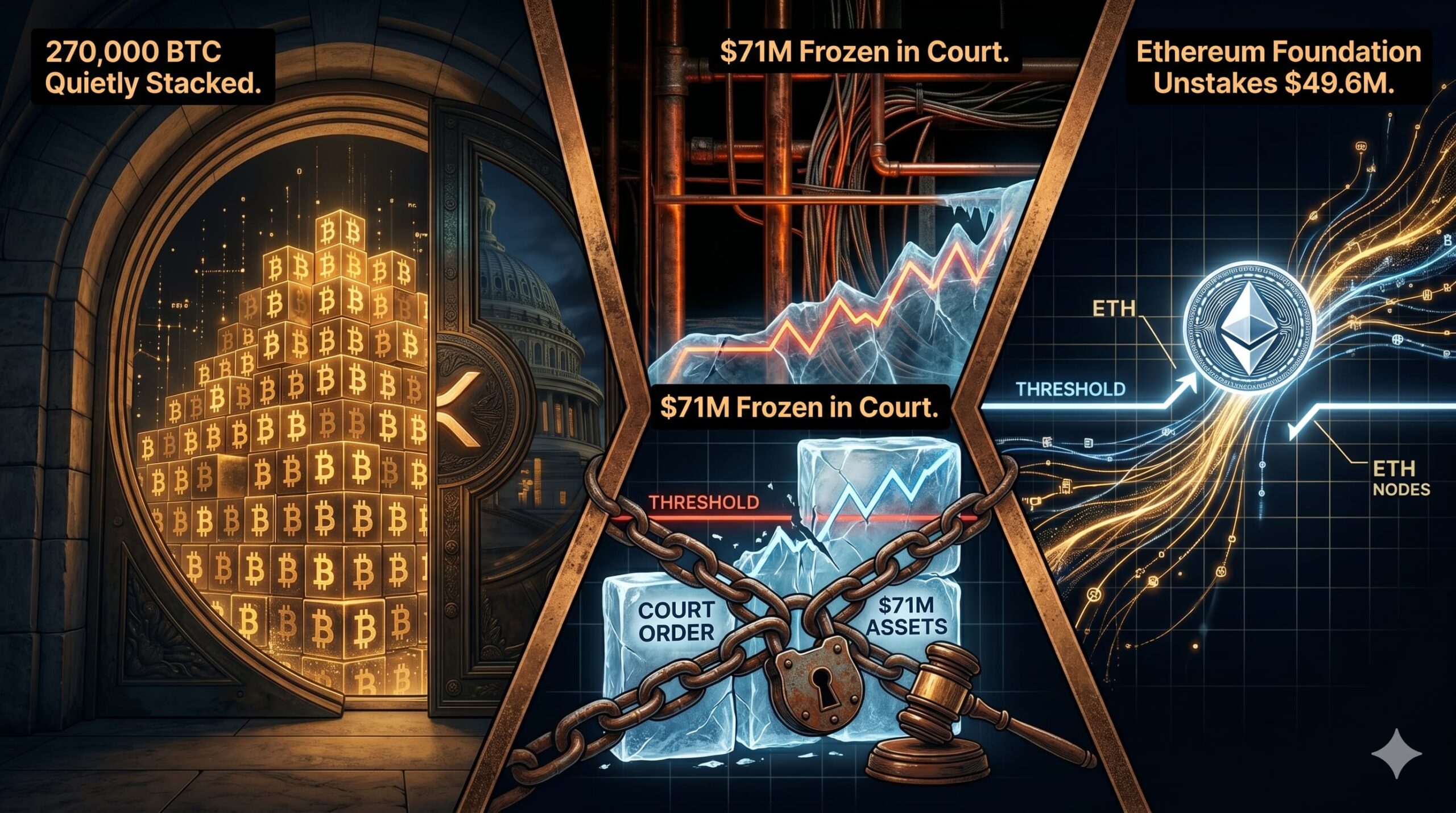
Over the last 30 days, whale wallets quietly accumulated 270,000 BTC — the single largest monthly whale buy since 2013. Exchange reserves hit a 7-year low. BlackRock absorbed $2.44 billion worth of Bitcoin in April alone. A federal judge in Manhattan just authorised the transfer of $71 million in frozen DeFi exploit funds. And on May 11, Arkham confirmed the Ethereum Foundation unstaked $49.6 million in ETH — silently, without announcement.
This is the Kaaltrix Daily Intelligence Briefing. Here is everything that matters, and what the data actually shows.
1. Bitcoin Whale Accumulation Hits a 13-Year High While Retail Sells
What happened: According to on-chain analysis published by SpotedCrypto and corroborated by CryptoQuant data, wallets holding at least 1,000 BTC net-purchased 270,000 BTC over the 30 days ending April 20, 2026. That is approximately $21.6 billion worth of Bitcoin bought at an average cost basis in the $60,000–$80,000 range.
The number of whale wallets holding 1,000+ BTC grew from 2,082 in December 2025 to 2,140 by April 2026 — an increase of 58 wallets. Concentrated buying in the $60,000–$70,000 price band has absorbed 429,000 BTC in aggregate over a longer window.
The exchange reserves context: This accumulation is happening as Bitcoin on exchanges hits a 7-year low. As of late April 2026, only 2.21 million BTC remain on centralised exchanges — representing 5.88% of circulating supply, the lowest share since December 2017. The 30-day net outflow from exchanges reached negative 48,200 BTC. The single largest exit occurred on March 7: 32,000 BTC, equivalent to $2.26 billion, left exchanges in a single session.
CryptoQuant CEO Ki Young Ju described the dynamic clearly: “Exchange whale ratio decline with accelerating outflows signals large holders shifting from distribution to accumulation.”
What this means structurally: Three forces are driving exchange reserve depletion simultaneously. First, ETF custodians are moving coins into cold storage — permanently removing them from the active sell-side float. Second, the self-custody movement accelerated by the FTX collapse in 2022 has permanently reshaped holder behaviour, with hardware wallet adoption at record levels through early 2026. Third, DeFi protocols are pulling Bitcoin into wrapped and bridged formats for yield, removing it from centralised order books.
Long-term holders now control 78.3% of circulating supply, up from 74.1%. The MVRV Z-Score sits at 1.2 — well below the cycle peak of 3.8. In every historical instance where MVRV has been at this level, Bitcoin has produced a positive 12-month return.
Important caveat: Q1 2026 was the first time in Bitcoin’s history that all three calendar months of Q1 closed in the red. As of today, May 14, BTC is trading at approximately $79,528. The $80,000 level has capped the latest recovery attempt. Until a decisive break above that resistance is confirmed on volume, the whale accumulation data is a positioning signal — not a price catalyst yet.
What to watch: The single-day ETF inflow figure. On May 4, ETFs absorbed $532.21 million in a single session, with BlackRock’s IBIT alone responsible for $335.49 million. On May 7, IBIT added another $134.6 million. When these daily inflow numbers sustain above $200 million for three or more consecutive sessions, the supply-demand arithmetic at the $80,000 level becomes very difficult to maintain.
2. BlackRock Holds 812,000 BTC. ETFs Are Absorbing 9x Daily Mining Output.
The numbers: BlackRock’s IBIT ETF now holds approximately 812,000 BTC, equivalent to $66.9 billion in AUM as of May 7, 2026. That represents roughly 3.8% of total Bitcoin supply and places IBIT in the top 1% of all US ETFs by assets.
For April 2026 as a whole, IBIT captured $1.71 billion of the $2.44 billion in total US spot Bitcoin ETF net inflows — a 70% market share. BlackRock and Fidelity together control over 60% of net new institutional investment into Bitcoin.
The supply arithmetic: In a nine-day window in late April and early May, US spot Bitcoin ETFs absorbed approximately 19,000 BTC — nine times the amount produced by mining in that same period. The daily Bitcoin mining output is approximately 450 BTC. When ETF demand runs at multiples of supply creation for sustained periods, available float compresses mechanically, not narratively.
Total cumulative US spot Bitcoin ETF net inflows since the January 2024 launch have reached approximately $58.5 billion. Total ETF AUM is above $96.5 billion. US ETFs and publicly listed companies now collectively control roughly 12% of total Bitcoin supply, up from 9% a year ago.
Bloomberg Intelligence analyst Eric Balchunas stated after the week ending May 9: “Every single rolling period we track is now positive. Haven’t seen that in months.”
Strategy’s continued buying: MicroStrategy parent company Strategy purchased 535 BTC for approximately $43 million last week, at an average price of $80,340. The purchase was funded via common stock sales. Strategy’s total holdings are on approach to 600,000 BTC on a cumulative basis.
3. The Aave rsETH Exploit: $71 Million Frozen by a US Court, and What Happened On-Chain
This is the most consequential DeFi intelligence story of May 2026. Here is the full on-chain timeline.
April 18, 2026 — The Exploit: An attacker exploited a vulnerability in Kelp DAO’s LayerZero cross-chain bridge. The attacker fraudulently minted approximately 116,500 rsETH tokens without backing them with real assets — effectively creating collateral from nothing. The minted tokens were then deposited into Aave V3 as collateral, and the attacker borrowed wrapped ETH against them.
The result: over $190 million in bad debt created in a single transaction sequence. Aave’s total value locked dropped $12 billion within one week. Confidence across Ethereum and Arbitrum lending markets deteriorated rapidly.
On-chain evidence consistent with attribution to the Lazarus Group — North Korea’s state-sponsored hacking unit — was identified by security researchers. No court has formally concluded this attribution.
The Recovery Operation: A coalition operating under the name DeFi United coordinated the response. The recovery strategy centred on deliberately adjusting Aave’s price oracle parameters — a controversial but effective move that made forced liquidations technically executable. Without this adjustment, the attacker’s eight positions would have been structurally difficult to liquidate without further damage.
On May 6, 2026, all eight attacker positions were fully liquidated across Ethereum and Arbitrum. Ordinary Aave users were not impacted. The protocol’s Umbrella insurance mechanism was never activated. Recovered collateral was moved into a Recovery Guardian multi-signature wallet under the DeFi United framework.
The Legal Freeze: Before the recovery could complete, Gerstein Harrow LLP — representing families holding $877 million in unpaid terrorism judgments against North Korea — served a US court restraining notice on Arbitrum, freezing 30,765 ETH (approximately $71 million) in place. The argument: those funds are proceeds of a North Korean state actor’s cyberattack and should be available for seizure by terrorism judgment creditors.
An Arbitrum DAO snapshot vote produced over 90% support for transferring the frozen ETH to Aave. However, under Arbitrum’s governance process, the snapshot is non-binding. A formal Constitutional Arbitrum Improvement Protocol — an on-chain executable governance proposal — would be required to actually move funds.
The Court Ruling (May 9, 2026): Judge Margaret Garnett of the Southern District of New York issued a modified order permitting Arbitrum DAO to proceed with an on-chain governance vote to transfer the 30,765 ETH to an Aave-controlled wallet. The ruling explicitly protects governance participants from personal liability under the restraining notice. However, the legal freeze travels with the funds — the terrorism creditors’ claim is preserved and continues.
Aave Chief Legal and Policy Officer Linda Jeng, speaking at Consensus Miami, framed the outcome: “In the financial crisis, we had to bail out the banks. Here, we came together as an ecosystem to bail ourselves out.”
What this means for DeFi: The exploit demonstrated a vulnerability class — fraudulent cross-chain collateral — that affects any protocol accepting bridged assets without robust oracle validation. Aave’s post-incident review is expanding its collateral standards beyond financial metrics to include cybersecurity, interoperability, and technical architecture assessments. The broader implication for DeFi protocols accepting cross-chain collateral is significant: the oracle layer is now a primary attack surface.
The legal precedent is also notable: This appears to be the first case in which a US federal court has issued a restraining notice directly against a DAO’s on-chain holdings and then modified that notice to accommodate on-chain governance processes. The question of how traditional legal systems interact with autonomous on-chain governance is no longer theoretical.
4. Ethereum Foundation Unstakes $49.6 Million. Vitalik Sells Another 17,000 ETH.
The Ethereum Foundation move: On May 11, 2026, Arkham Intelligence confirmed via on-chain tracking that addresses linked to the Ethereum Foundation had unstaked approximately $49.6 million worth of ETH. The unstaking was executed without prior public announcement.
The Ethereum Foundation has historically unstaked ETH to fund operational expenses and ecosystem grants. This move does not inherently signal a strategic shift in ETH positioning — the Foundation has made similar withdrawals in prior years. However, the timing during a period of ETH/BTC ratio weakness and subdued retail sentiment means the optics are consequential, even if the substance is routine.
Vitalik Buterin’s wallet activity: Separately, on-chain data tracked by Investing.com shows that addresses linked to Vitalik Buterin reduced ETH holdings from approximately 241,000 ETH at the start of February 2026 to about 224,000 ETH — implying sales of roughly 17,000 ETH over the period. These transactions were executed via CoW Protocol in smaller, staggered batches designed to minimise price impact and slippage.
Buterin’s historical selling pattern has been associated with donations, ecosystem grants, and strategic allocations rather than macro timing. The absolute volume — 17,000 ETH — is modest relative to the 8.91 million ETH accumulated by non-founder whales in the same broader window. But founder-linked selling at any scale during a consolidation creates psychological overhead, particularly when ETH/BTC ratio is already at a 10-month low.
ETH accumulation continues elsewhere: Separate Santiment data covering the first week of May 2026 indicates large wallet holders accumulated over 140,000 ETH in a three-day window, valued at approximately $322 million. The aggregate ETH balance across sizable wallets climbed from 13.83 million to 13.98 million ETH during that period.
An unknown wallet tracked by Arkham has spent $46.99 million accumulating 21,800 ETH since February 15, at an average cost of $2,155 per coin. A separate, unrelated wallet holds 127,716 ETH worth approximately $292 million. The Ethereum supply held by short-term addresses — wallets holding under one week — has contracted from 3.2% to 2.1% of supply, confirming the exit of high-beta, short-term participants.
ETH/BTC context: As of May 12, the ETH/BTC ratio hit its lowest point in ten months. This metric is often interpreted as a gauge of risk appetite within crypto — when investors favour Bitcoin over Ethereum, it signals defensive positioning. The ratio’s decline does not reflect deteriorating Ethereum fundamentals. It reflects a market that is currently in risk-reduction mode following Q1 2026’s macro volatility. The Glamsterdam upgrade — targeting parallel transaction execution, 100 million+ gas per block, expanded blob capacity, and native account abstraction — remains on schedule for the first half of 2026 and represents the most significant network capacity expansion since the Merge.
5. Strategy Buys $43 Million in BTC. Metaplanet Books $725 Million Q1 Loss.
Strategy: MicroStrategy’s parent entity purchased an additional 535 BTC last week at approximately $80,340 per coin, deploying $43 million in capital raised through common stock issuance. The purchase continues Strategy’s consistent accumulation pattern across market cycles.
Metaplanet: Japanese investment firm Metaplanet reported a ¥114.5 billion ($725 million) net loss for Q1 fiscal 2026, driven by accounting valuation losses on its Bitcoin treasury following BTC’s worst Q1 since 2018. Metaplanet’s total Bitcoin stack reached 40,177 BTC as of the report. Accounting rules in Japan requiring mark-to-market valuation of Bitcoin holdings mean unrealised drawdowns flow directly through the income statement. The loss reflects the accounting treatment, not a realised sale.
What the Data Collectively Shows
The on-chain picture entering the week of May 14, 2026 is a textbook divergence between sentiment and positioning.
Sentiment, as measured by Fear & Greed at 40, is fearful. Price, at $79,528 BTC and $2,255 ETH, is well below all-time highs. Retail activity is subdued.
Positioning, as measured by exchange reserves (7-year low), whale accumulation (13-year high monthly rate), ETF inflows (first week above $1 billion since January 2026), and long-term holder supply (78.3% — near record highs), is the opposite of what a structurally broken market looks like.
Every historical precedent where whale accumulation occurred at this scale during a fear-driven retail capitulation — 2015, 2019, and 2020 — was followed by a significant price recovery. This is not a prediction. Timing is always uncertain, and the bear market may not fully clear until Q3 2026 according to multiple analyst models.
What it is: a signal that the entities with the most information and the longest time horizons are not selling. They are buying, quietly, while the price remains suppressed and the headlines remain negative.
That divergence is, historically, where the most important intelligence sits.
All on-chain data sourced from Etherscan, Arkham Intelligence, Nansen, CryptoQuant, and SpotedCrypto. ETF data sourced from Bloomberg Intelligence, tokenist.com, and fund disclosures. Legal information sourced from CoinDesk court reporting. This article is for informational purposes only and does not constitute financial advice. See our full disclaimer at kaaltrix.com/disclaimer.